Temperature Sensor
Price on request
Temperature Sensor
Available on back-order
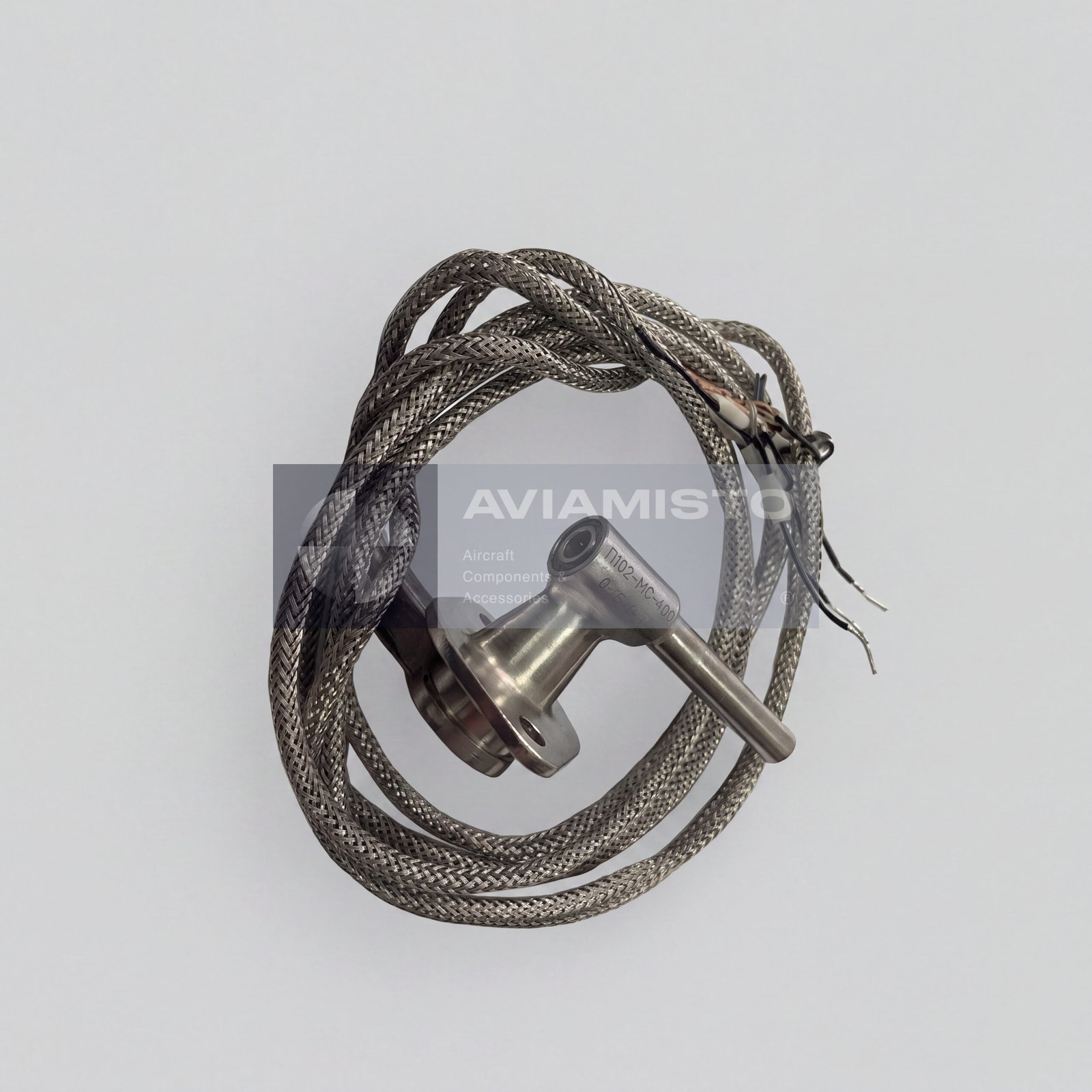
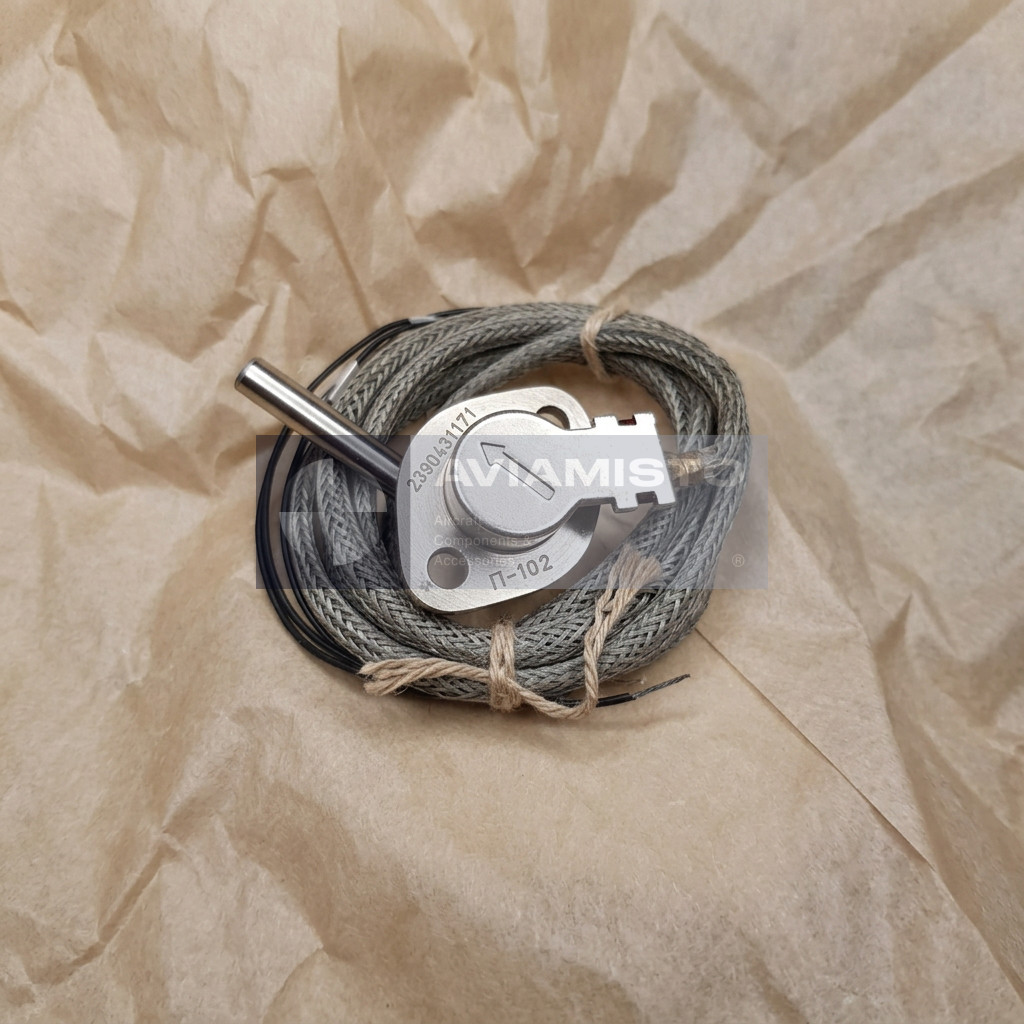
P-102 / P102-MS-400 aircraft temperature sensor P-102, full factory designation P102-MS-400, is an aircraft resistive temperature sensor used to measure stagnation temperature of an air flow. The sensor converts air temperature into an electrical resistance signal and transmits this signal to electronic engine regulators, automatic control systems and other aircraft equipment. It is used where accurate temperature information is required for engine control, air-system regulation or thermal monitoring. Function of the P-102 temperature receiver The main function of P-102 is to measure the temperature of the controlled air flow or thermal zone and provide an analog resistance output. The unit operates on the principle of a resistance thermometer: the electrical resistance of the sensing element changes according to temperature. This signal is then used by onboard systems for calculation, regulation or protection functions. In engine-control applications, air temperature data can support fuel scheduling and control of gas-turbine operating modes. P102-MS-400 construction and sensing elements P102-MS-400 is built as a flanged immersion-type aircraft resistance thermometer. The unit has a metal body with a mounting flange and an immersion probe containing the sensing elements. According to the source context, the sensor includes two independent measuring resistors, which provide two separate output resistance signals. This dual-channel arrangement allows redundancy or parallel use by different onboard circuits. A fixed cable lead connects the resistors to the aircraft wiring system. Installation areas of the P-102 sensor The P-102 sensor is installed directly on an engine housing, air duct, inlet assembly or controlled equipment body, depending on the aircraft system. The working probe is immersed into the monitored air flow or thermal zone, while the cable lead remains outside for connection to the onboard network. The source context indicates possible use in gas-turbine engine flow paths, inlet guide vane areas, anti-icing air ducts, air-conditioning systems and thermal monitoring areas of engine-control equipment. Measurement accuracy and response of P102-MS-400 P102-MS-400 provides temperature measurement over a wide aircraft operating range. Its static error depends on the temperature interval, while dynamic behavior is defined by the time constant in airflow. The source context specifies a response time limit when the airflow speed is at least 45 m/s. Each sensor is supplied with individual calibration data showing resistance versus temperature at defined reference points, which allows the receiving equipment or maintenance personnel to verify the sensor characteristics. Ordering and replacement of P-102 / P102-MS-400 When ordering P-102 / P102-MS-400, the buyer should confirm the exact designation, cable length, mounting configuration and required documentation. Since aircraft temperature sensors can be similar in appearance but differ by resistance curve, calibration category, cable assembly and mounting interface, replacement must be checked against the aircraft or engine system documentation. Product passport, calibration table, test report, storage records and condition should be confirmed before supply.
P-102 / P102-MS-400 is a Temperature Sensor that converts the temperature of the monitored medium into a signal for the associated instrument or system. The exact execution is determined by the complete marking, series and documentation. A similar housing, common opening characters or a related function does not establish matching ratings.
This category contains different equipment classes: temperature receivers, thermometers, air- and liquid-pressure receivers, regulators and individual measurement units. The actual function of the item is therefore more important than the broad category name. Read the designation with every letter, digit, hyphen, version and series reference preserved.
The item converts the temperature of the monitored medium into a signal for the associated instrument or system. It is not necessarily a stand-alone indicator; depending on the design, it may operate with a remote indicator, regulator, pressure line or measurement set. The applicable documentation defines the circuit, medium, supply, range and connection arrangement.
For a temperature item, confirm the sensing principle, monitored medium, range and compatible indicator. For a pressure receiver, also confirm pressure type, channel count, ports, heating, drainage and connected lines. An RF measurement receiver must be selected by its own radio-frequency data rather than by requirements intended for an aircraft pressure or temperature sensor.
Before ordering, compare the primary and alternative designations, execution, range, output, electrical supply, connector or ports, mounting, dimensions and mass whenever documented. Numerical values in Technical Details are retained from the previous card or a supporting source and must be checked against the passport for the actual unit.
Related modifications may differ in channel count, resistance, calibration, working medium, measurement limit, heater voltage or mounting interface. Do not treat them as interchangeable without an explicit documentary reference. General technical background is available under Temperature Sensor.
Incoming inspection includes checking the marking and documentation and examining the housing, sensing element, connector, pressure ports, drainage holes, mounting points and seals as applicable. Reject or investigate cracks, deformation, corrosion, contaminated passages and damaged contacts. Test the unit under the approved procedure for the exact execution.
After installation, check line tightness or electrical continuity, routing of pressure lines and wiring, and then perform the prescribed functional test. External integrity alone does not establish measurement accuracy. Assign an aircraft application only when supported by a passport, illustrated parts catalogue or maintenance document.
Functionally related products include P-77 Version 2, P-109, P-64, P-125. They are grouped by measurement function for navigation and do not imply interchangeability. More items are listed in the Pressure & Temperature Sensors category.
An enquiry for P-102 / P102-MS-400 should state the complete designation, quantity, required condition, marking photograph, delivery scope and required documents. When available, identify the associated indicator, regulator or system. Price, actual availability, condition, lead time and documentation are confirmed separately for the offered unit.
Product Type: Temperature Sensor
Primary Designation: P-102 / P102-MS-400
Alternative Designations: P-102 / P102-MS-400; P-102/P102-MS-400; P 102 P102 MS 400; П-102 / П102-МС-400
Function: converts the temperature of the monitored medium into a signal for the associated instrument or system
Selection Basis: Complete designation, execution, marking and passport for the specific item
Range and Signal: Only as stated in retained data and documentation for the exact execution
Interface: Confirm connector, ports, channel count, supply or heating before installation
Application: Only as supported by the passport, parts catalogue or approved installation documentation
Interchangeability: Not established by a similar index, housing or function
Inspection: Inspect marking, housing and interfaces; bench-test under the approved procedure
Documentation: Product passport and approved operating or repair documentation
Category: Pressure & Temperature Sensors
Retained Technical Data:
Product Type: Aircraft resistive temperature sensor / air temperature receiver
Designation: P102-MS-400
Alternative Designations: P-102, P102, P102-MS-400, П-102, П102-МС-400, датчик температуры П-102
Function: Measurement of air-flow stagnation temperature and output of resistance signal
Measurement Principle: Resistance thermometer principle
Measured Medium: Air flow / controlled air environment depending on system installation
Application / Where Used: Electronic engine regulators, automatic control systems, engine air paths, anti-icing ducts and air-conditioning systems
Compatible Equipment: Gas-turbine aircraft engines and aircraft air systems depending on documentation
Sensor Construction: Flanged immersion-type metal sensor with protective probe and cable lead
Number of Measuring Channels: 2 independent measuring resistors
Output Signal: Two isolated analog resistance signals
Temperature Measurement Range: −60 °C to +200 °C
Resistance at 0 °C: 46 ±0.25 Ω
Static Error at +30…+110 °C: ±2 °C
Static Error at +110…+170 °C: ±3 °C
Time Constant: Not more than 6 seconds at airflow speed ≥45 m/s
Calibration Category: Category II according to OST92-0694
Calibration Data: Resistance-temperature table in product passport
Reference Calibration Points: −100, −50, 0, +20, +50, +100, +150 and +200 °C, according to source context
Cable Length Reference: 1500 ±30 mm, according to source context
Cable Type: Shielded aircraft cable in heat-resistant braid, according to source context
Mounting: Round welded metal flange with mounting holes
Immersion Part: Cylindrical probe with fixed sensing elements inside protective sheath
Sealing: Monolithic sealed construction
Weight: Not more than 0.12 kg
Technical Documentation: Product passport, calibration table, test report, storage records and aircraft system documentation if available
All shipments are carried out from our international warehouse in Dubai (UAE), as well as from our partners’ remote warehouses.
In Stock — items available in stock at the Dubai warehouse are dispatched within 5–10 business days after receiving 100% prepayment.
Remote Stock — items available at our partners’ remote warehouses are supplied within an average of 30–45 business days after receiving 100% prepayment.
Pre-Order — made-to-order products are manufactured and delivered within an average of 45–60 business days. Payment terms: 50% advance payment to start production, with the remaining 50% paid before dispatch from the Dubai warehouse after full readiness for shipment.
Returns & Changes (Restocking Fee)
For selected items, a RESTOCKING FEE of 10% may apply in case of return, order cancellation, or changes to the order specifications. This condition applies only to certain products and is confirmed at the order approval stage.
Warranty
All products are covered by a standard 6-month warranty.
Extended warranty is available upon request and is agreed individually; it may affect the final product price.
P-102 / P102-MS-400 aircraft temperature sensor P-102, full factory designation P102-MS-400, is an aircraft resistive temperature sensor used to measure stagnation temperature of an air flow. The sensor converts air temperature into an electrical resistance signal and transmits this signal to electronic engine regulators, automatic control systems and other aircraft equipment. It is used where accurate temperature information is required for engine control, air-system regulation or thermal monitoring. Function of the P-102 temperature receiver The main function of P-102 is to measure the temperature of the controlled air flow or thermal zone and provide an analog resistance output. The unit operates on the principle of a resistance thermometer: the electrical resistance of the sensing element changes according to temperature. This signal is then used by onboard systems for calculation, regulation or protection functions. In engine-control applications, air temperature data can support fuel scheduling and control of gas-turbine operating modes. P102-MS-400 construction and sensing elements P102-MS-400 is built as a flanged immersion-type aircraft resistance thermometer. The unit has a metal body with a mounting flange and an immersion probe containing the sensing elements. According to the source context, the sensor includes two independent measuring resistors, which provide two separate output resistance signals. This dual-channel arrangement allows redundancy or parallel use by different onboard circuits. A fixed cable lead connects the resistors to the aircraft wiring system. Installation areas of the P-102 sensor The P-102 sensor is installed directly on an engine housing, air duct, inlet assembly or controlled equipment body, depending on the aircraft system. The working probe is immersed into the monitored air flow or thermal zone, while the cable lead remains outside for connection to the onboard network. The source context indicates possible use in gas-turbine engine flow paths, inlet guide vane areas, anti-icing air ducts, air-conditioning systems and thermal monitoring areas of engine-control equipment. Measurement accuracy and response of P102-MS-400 P102-MS-400 provides temperature measurement over a wide aircraft operating range. Its static error depends on the temperature interval, while dynamic behavior is defined by the time constant in airflow. The source context specifies a response time limit when the airflow speed is at least 45 m/s. Each sensor is supplied with individual calibration data showing resistance versus temperature at defined reference points, which allows the receiving equipment or maintenance personnel to verify the sensor characteristics. Ordering and replacement of P-102 / P102-MS-400 When ordering P-102 / P102-MS-400, the buyer should confirm the exact designation, cable length, mounting configuration and required documentation. Since aircraft temperature sensors can be similar in appearance but differ by resistance curve, calibration category, cable assembly and mounting interface, replacement must be checked against the aircraft or engine system documentation. Product passport, calibration table, test report, storage records and condition should be confirmed before supply.
P-102 / P102-MS-400 is a Temperature Sensor that converts the temperature of the monitored medium into a signal for the associated instrument or system. The exact execution is determined by the complete marking, series and documentation. A similar housing, common opening characters or a related function does not establish matching ratings.
This category contains different equipment classes: temperature receivers, thermometers, air- and liquid-pressure receivers, regulators and individual measurement units. The actual function of the item is therefore more important than the broad category name. Read the designation with every letter, digit, hyphen, version and series reference preserved.
The item converts the temperature of the monitored medium into a signal for the associated instrument or system. It is not necessarily a stand-alone indicator; depending on the design, it may operate with a remote indicator, regulator, pressure line or measurement set. The applicable documentation defines the circuit, medium, supply, range and connection arrangement.
For a temperature item, confirm the sensing principle, monitored medium, range and compatible indicator. For a pressure receiver, also confirm pressure type, channel count, ports, heating, drainage and connected lines. An RF measurement receiver must be selected by its own radio-frequency data rather than by requirements intended for an aircraft pressure or temperature sensor.
Before ordering, compare the primary and alternative designations, execution, range, output, electrical supply, connector or ports, mounting, dimensions and mass whenever documented. Numerical values in Technical Details are retained from the previous card or a supporting source and must be checked against the passport for the actual unit.
Related modifications may differ in channel count, resistance, calibration, working medium, measurement limit, heater voltage or mounting interface. Do not treat them as interchangeable without an explicit documentary reference. General technical background is available under Temperature Sensor.
Incoming inspection includes checking the marking and documentation and examining the housing, sensing element, connector, pressure ports, drainage holes, mounting points and seals as applicable. Reject or investigate cracks, deformation, corrosion, contaminated passages and damaged contacts. Test the unit under the approved procedure for the exact execution.
After installation, check line tightness or electrical continuity, routing of pressure lines and wiring, and then perform the prescribed functional test. External integrity alone does not establish measurement accuracy. Assign an aircraft application only when supported by a passport, illustrated parts catalogue or maintenance document.
Functionally related products include P-77 Version 2, P-109, P-64, P-125. They are grouped by measurement function for navigation and do not imply interchangeability. More items are listed in the Pressure & Temperature Sensors category.
An enquiry for P-102 / P102-MS-400 should state the complete designation, quantity, required condition, marking photograph, delivery scope and required documents. When available, identify the associated indicator, regulator or system. Price, actual availability, condition, lead time and documentation are confirmed separately for the offered unit.
Product Type: Temperature Sensor
Primary Designation: P-102 / P102-MS-400
Alternative Designations: P-102 / P102-MS-400; P-102/P102-MS-400; P 102 P102 MS 400; П-102 / П102-МС-400
Function: converts the temperature of the monitored medium into a signal for the associated instrument or system
Selection Basis: Complete designation, execution, marking and passport for the specific item
Range and Signal: Only as stated in retained data and documentation for the exact execution
Interface: Confirm connector, ports, channel count, supply or heating before installation
Application: Only as supported by the passport, parts catalogue or approved installation documentation
Interchangeability: Not established by a similar index, housing or function
Inspection: Inspect marking, housing and interfaces; bench-test under the approved procedure
Documentation: Product passport and approved operating or repair documentation
Category: Pressure & Temperature Sensors
Retained Technical Data:
Product Type: Aircraft resistive temperature sensor / air temperature receiver
Designation: P102-MS-400
Alternative Designations: P-102, P102, P102-MS-400, П-102, П102-МС-400, датчик температуры П-102
Function: Measurement of air-flow stagnation temperature and output of resistance signal
Measurement Principle: Resistance thermometer principle
Measured Medium: Air flow / controlled air environment depending on system installation
Application / Where Used: Electronic engine regulators, automatic control systems, engine air paths, anti-icing ducts and air-conditioning systems
Compatible Equipment: Gas-turbine aircraft engines and aircraft air systems depending on documentation
Sensor Construction: Flanged immersion-type metal sensor with protective probe and cable lead
Number of Measuring Channels: 2 independent measuring resistors
Output Signal: Two isolated analog resistance signals
Temperature Measurement Range: −60 °C to +200 °C
Resistance at 0 °C: 46 ±0.25 Ω
Static Error at +30…+110 °C: ±2 °C
Static Error at +110…+170 °C: ±3 °C
Time Constant: Not more than 6 seconds at airflow speed ≥45 m/s
Calibration Category: Category II according to OST92-0694
Calibration Data: Resistance-temperature table in product passport
Reference Calibration Points: −100, −50, 0, +20, +50, +100, +150 and +200 °C, according to source context
Cable Length Reference: 1500 ±30 mm, according to source context
Cable Type: Shielded aircraft cable in heat-resistant braid, according to source context
Mounting: Round welded metal flange with mounting holes
Immersion Part: Cylindrical probe with fixed sensing elements inside protective sheath
Sealing: Monolithic sealed construction
Weight: Not more than 0.12 kg
Technical Documentation: Product passport, calibration table, test report, storage records and aircraft system documentation if available
All shipments are carried out from our international warehouse in Dubai (UAE), as well as from our partners’ remote warehouses.
In Stock — items available in stock at the Dubai warehouse are dispatched within 5–10 business days after receiving 100% prepayment.
Remote Stock — items available at our partners’ remote warehouses are supplied within an average of 30–45 business days after receiving 100% prepayment.
Pre-Order — made-to-order products are manufactured and delivered within an average of 45–60 business days. Payment terms: 50% advance payment to start production, with the remaining 50% paid before dispatch from the Dubai warehouse after full readiness for shipment.
Returns & Changes (Restocking Fee)
For selected items, a RESTOCKING FEE of 10% may apply in case of return, order cancellation, or changes to the order specifications. This condition applies only to certain products and is confirmed at the order approval stage.
Warranty
All products are covered by a standard 6-month warranty.
Extended warranty is available upon request and is agreed individually; it may affect the final product price.